Memorial Care
Greek Orthodox Memorial Traditions: 40 Days, 1 Year and Beyond
Headstone cleaning from £75 — before & after photos with every visit.
No need to attend. Free written quote, usually within 24 hours.
In short: Greek Orthodox families hold memorial services (mnimosyna) at 40 days, three months, six months, one year and annually thereafter. The grave is visited and tended around each, and kollyva (boiled wheat) is shared as a symbol of the resurrection and eternal life. Because memorials are usually soft white marble that weathers in London’s damp, polluted air, families clean and care for them gently throughout this cycle.
In the Greek and Greek-Cypriot Orthodox tradition, remembrance is not a single moment but an unfolding rhythm — a series of services and visits that carry a family through the first raw year of grief and then onward, year after year. Each gathering is an act of love and prayer for the departed, and very often it is also the moment a family stands again at the graveside. Understanding that rhythm helps explain why the memorial itself matters so much, and why so many London families wish to see it kept clean and dignified at every stage.
The cycle of memorial services (mnimosyna)
The memorial services known collectively as mnimosyna (singular mnimosyno) are prayers for the soul of the departed, traditionally offered at intervals after the death. While the exact pattern varies between parishes, communities and families, the milestones most commonly observed are:
- 40 days — among the most significant of all, observed by very many families
- Three months and six months
- Nine months, as observed in some communities
- One year — the first anniversary, often deeply felt
- Three years, and then annually thereafter
It is worth saying plainly that practice is not uniform. Some families keep every one of these dates; others mark a smaller number according to their parish custom, their priest’s guidance or what feels right for them. There is no single rigid rule, and a family should always feel free to follow the tradition as their own community keeps it. What unites them all is the same intention: to remember, to pray and to gather.
Around each service the grave naturally comes into focus. Relatives travel, sometimes from abroad, and the family wants the memorial to look its best for the occasion.
What is kollyva?
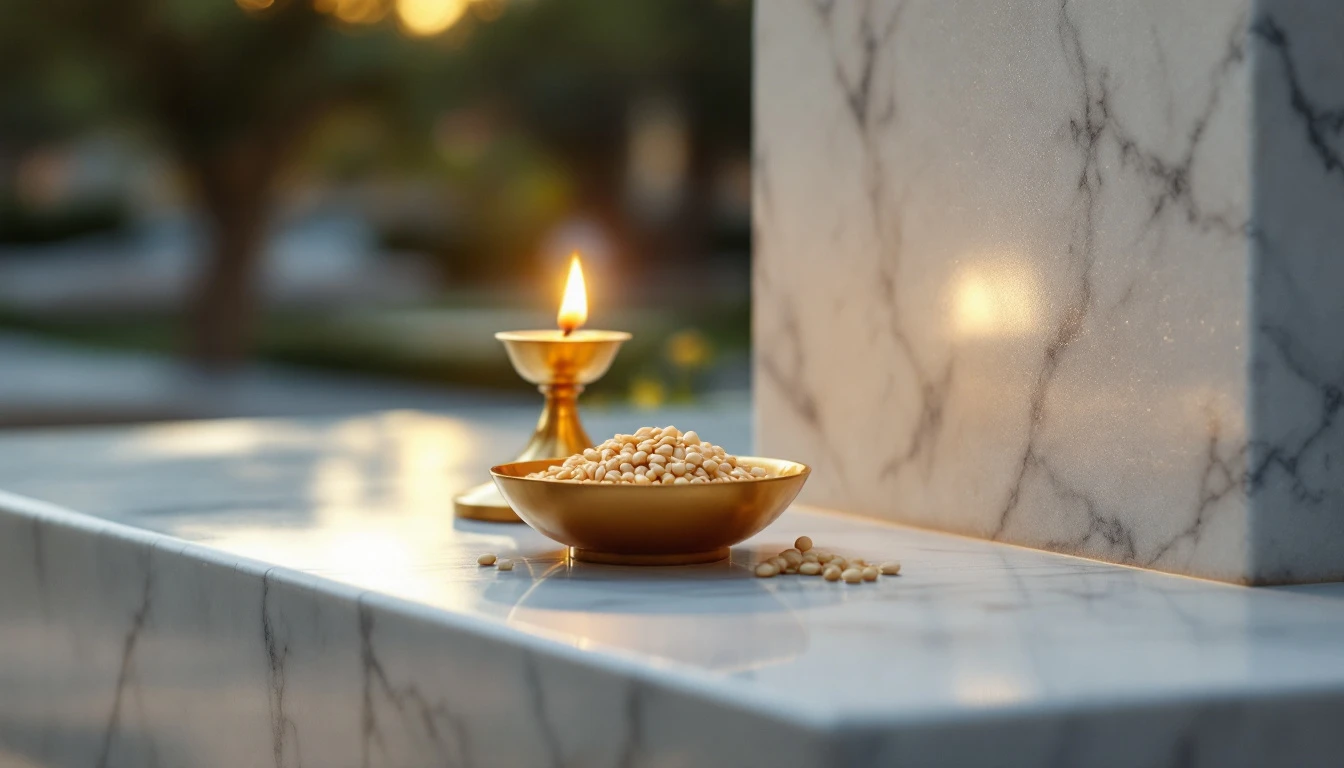
A custom many people associate immediately with Greek Orthodox remembrance is kollyva — boiled wheat, sweetened and beautifully decorated, often with sugar, pomegranate seeds, nuts, raisins and sometimes a cross or the initials of the departed marked on top. It is blessed during the memorial service and then shared with the congregation in memory of the loved one.
The wheat carries a gentle theological meaning drawn from scripture: just as a grain of wheat falls into the earth and rises again as new life, so the faithful look to the resurrection and to eternal life. Sharing kollyva is therefore both a remembrance and an expression of hope — a quiet, edible symbol that death is not the end.
The kandili (grave lamp)
Many Orthodox graves are tended with a kandili, a small oil lamp kept burning at the memorial. The flame is a symbol of the soul, of prayer and of the light of faith continuing beyond death. Families top up the oil, trim or replace the wick and relight the lamp on their visits, often timed around the memorial services.
Caring for the kandili is part of caring for the grave as a whole. Soot from the lamp, spilled oil and the residue of candles can mark the surrounding stone over time, which is one more reason gentle, regular attention to the memorial matters.
Why Greek Orthodox marble memorials need special care
Greek Orthodox memorials are frequently elaborate and made of white marble — often imported, finely carved and highly polished. Marble is beautiful, but it is also comparatively soft and chemically vulnerable, and London is hard on it. In the capital’s damp, polluted air, white marble tends to grey and yellow, while algae, lichen and black biological staining take hold in the carved detail and lettering.
The temptation is to attack this with something strong. It must be resisted. Acidic cleaners and high-pressure washing should never be used on marble. Acid eats into the calcium-based stone, dulling the polish permanently and etching the surface; pressure washing can blast away the skin of the marble, open the grain to further soiling and chip fine carving. The damage is usually irreversible.
The correct approach is patient and gentle: soft brushes, plenty of clean water, and where appropriate a pH-neutral or specialist biocidal treatment that lifts staining slowly without harming the stone. If you would like to understand how different memorials should be treated, our guide to headstone stone types and how to clean them explains why marble needs a lighter touch than granite. For marble memorials specifically, our professional headstone cleaning uses methods chosen to protect the stone, and you can read more on our dedicated Greek Orthodox memorial care page.
Caring for the grave around the calendar
Because remembrance follows a calendar, so does the care of the memorial. Many families ask us to clean and tidy the grave before each memorial service, so that when relatives gather for the 40-day, the one-year or an annual mnimosyno, the stone is clean, the lettering legible and the plot dignified.
This is where a regular arrangement helps. A grave maintenance plan timed to these dates keeps the memorial cared for all year round, sparing the family the worry of organising it each time — particularly when relatives live far from the cemetery. We serve Greek Orthodox families across London, including at New Southgate Cemetery, home to a large Greek Orthodox community, and the historic Greek section at West Norwood Cemetery.
Frequently asked questions
What is the 40 day memorial? The 40-day memorial (mnimosyno) is one of the most important services after a Greek Orthodox death. It is a service of prayer for the departed, held around forty days after passing, when family and friends gather, often share kollyva, and visit the grave. Many families regard it as a key moment in the first stage of mourning.
Why is the marble going yellow? White marble naturally discolours in London’s damp, polluted air. Airborne pollution, rain, algae and lichen leave the surface looking grey, yellowed and stained over time. With gentle, correct cleaning the brightness can usually be greatly improved — but only if harsh acids and pressure washing are kept well away from the stone.
How often should the grave be cleaned? That is for each family to decide, but many find it natural to have the memorial cleaned ahead of each memorial service and then maintained between times. A plan timed to the family’s own calendar of remembrance works well.
At Memorial Guardian London we have great respect for the traditions families carry, and for the memorials that hold their memories. We care for marble Greek Orthodox memorials gently and properly, so they remain a fitting place of remembrance through every mnimosyno. If we can help your family, please get in touch for a free, no-obligation quote.
Headstone cleaning from £75 — before & after photos with every visit.
No need to attend. Free written quote, usually within 24 hours.
About the author
Dom Deacon
Memorial Care Specialist, Memorial Guardian London
Dom Deacon has worked in memorial care and grave cleaning for more than 10 years, and oversees cleaning and conservation for Memorial Guardian London, caring for graves and headstones across all 32 London boroughs. He works to conservation-minded standards — water and stone-safe methods only, never bleach, acid or pressure washers.